
Picture an owner who pays for an AI writing tool so proposals go out faster. The proposals were never the slow part. New enquiries waited two days for a first reply, and by then half of them had hired someone else. The tool works fine. The business still loses the work.
That owner is made up. The pattern is not. RAND interviewed 65 experienced data scientists and engineers about why AI projects fail. The most common cause they found: people misunderstand what problem needs to be solved.
This is a plain guide to the AI audit for small business owners. We run these audits at NocodePro, and I'll use ours as the example throughout.
First, the name. It means three different things.
What is an AI audit?
An AI audit for a small business is a structured look at how the business actually runs, done before anyone picks a tool. It follows the work one process at a time, counts what each process costs in hours and money, and ends with a short ranked list: what to fix first, what it's worth, and what to leave alone.
Three things people call an AI audit
Search the term and you'll find three different services under one name:
- Auditing AI systems. IBM defines an AI audit as "a structured, evidence-based examination of how artificial intelligence (AI) systems are designed, trained and deployed." It checks that the AI a company already runs is safe and within the law. It's mainly for companies that build AI or use it for regulated decisions, such as lending or hiring.
- An AI visibility audit. How ChatGPT and AI search engines find and describe your business. A marketing check, close to SEO.
- An audit of your business for AI opportunities. Where AI or automation would pay for itself in the way you work today.
This guide is about the third kind. If you came for the first, IBM's guide is the one you want.
Why most businesses skip the step that matters most
The step that matters most is the diagnosis: looking at how the work runs before deciding what to buy. It's also the step most businesses skip, for two reasons.
It isn't a product. You can buy a tool on a Tuesday afternoon. A diagnosis takes a few hours of your attention, and what it finds is mostly not AI. Most of what an honest audit turns up is lost hours, late replies and missed invoices. The fix is usually a tool you buy or a rule you write down. When AI shows up, it's usually a layer on top of those rules. Even a good AI agent can only follow a process somebody has worked out.
RAND found the same thing. Projects fail when a company "focuses more on using the latest and greatest technology than on solving real problems for its intended users."
It's uncomfortable. Day to day, you do the work. You don't step back and look at what it costs. An audit asks you to look at your own numbers, and for most owners that sits well outside the daily comfort zone. I understand that. But the numbers are where the lost money shows up.
I sometimes call AI a magic wand myself. It can do a surprising amount. RAND's report says it more carefully: "AI is not a magic wand that can make any challenging problem disappear." Either way, AI can't tell you which problem to use it on.
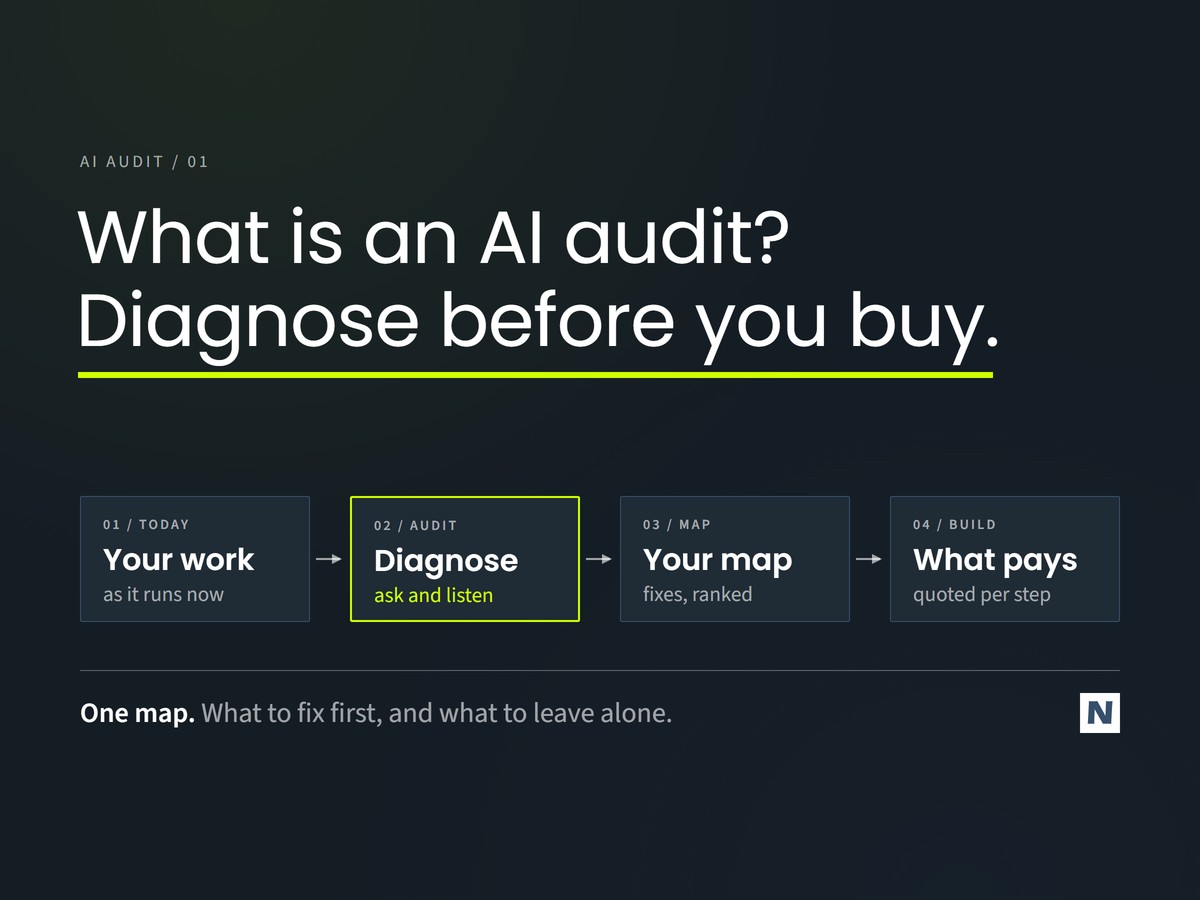
We diagnose first. Then we build.
What an AI audit looks at
An audit takes one process at a time (sending quotes, answering new enquiries, invoicing) and counts what it really costs. Hours are only part of it. There are four costs:
- Hours. How often it happens and how long it takes. Forty jobs a week at 15 minutes each is 10 hours a week.
- Mistakes. The quote sent with last year's price. The invoice that had to be reissued. And the hour it took to put each one right.
- Money never earned. The enquiry nobody answered in time. The quote nobody chased.
- Wasted spend. The subscription you keep only because two tools don't talk to each other.
These are examples, not a client's numbers.
A good audit also does a few things a checklist can't.
It maps where the data lives: which system holds the client list, and which one the invoices. A fix that needs data from three places is a different job from one that needs data from one.
It asks the people who do the work, not only the owner. The person who sends the invoices often knows better than the person who signs them where the hours go. When their numbers differ, both get written down.
And it follows one piece of work from start to finish before ranking anything. The process you'd name as the worst is often not the most expensive one. Walking a single enquiry from the first call to the paid invoice shows the cost nobody thought to mention.
The fix often turns out to be plain rules with AI making one decision inside them. Our email triage flow works that way: a small AI model makes one decision about each email, and plain automation does the rest.
What happens in an AI audit, step by step
Here's how ours runs. Other firms differ in the details, but the shape should be similar: questions first, answers later.
- A first call, 20 to 30 minutes, free. What the company does, who does what, which tools you run on. Then you decide whether to go further.
- A prep email. Six questions, about 30 minutes of your time. It maps your recurring work and where the data lives, so the main call can go into detail instead of collecting the basics.
- The audit call, on video. We plan it for 90 minutes. After a number of audits, I can tell you it almost always runs longer, so keep two hours free. We ask and listen, and map your processes step by step. We don't pitch solutions on the call. That's deliberate: diagnosis first.
- The results, within a week. Your map arrives as a live page at your own private link, and we walk through it together in 30 minutes.
Add it up: about three and a half hours of your time, spread over roughly two weeks. That's all the time it asks of you. The AI consulting page has the same steps in full.
What an AI audit includes
Most guides describe what you get at the end. Here's ours, so you can look at it yourself. We call it the AI Opportunity Map, and it holds:
- a one-paragraph summary of where the hours and the money go
- one picture of how a piece of work moves through the business today, with the losses marked
- the fixes, ranked by what each one gives back in hours and money
- one page per finding: what happens now, why it costs time or money, what fixes it, and what you get back
- quick wins, the hours you can take back before anything is built
- what not to automate, where a person should stay in charge
- where to start, and why that fix goes first
- your numbers, each traced to an assumption you can change
That last part matters more than it sounds. Move a slider (your hourly cost, say) and every total recalculates. You don't have to trust our assumptions. You can replace them with yours.
Open the sample report. It's built for a made-up heating and electrical firm: eleven processes, six fixes, and three areas we advise leaving to people.
One honest limit. The map is only as good as what the call uncovers. A cost nobody mentions, and that no step of the work shows, stays invisible. That's why we follow a whole piece of work instead of collecting a list of complaints.
How to tell a real AI audit from a sales call
Search "AI audit for small business" and page one includes videos teaching people to sell AI audits as a side business, with titles promising $1,000 to $100,000 per audit. You'll meet sellers before you meet anyone else. Watch for these:
- Tools get named before anyone has mapped how your work runs.
- There are no numbers, or numbers with no assumption behind them.
- Every finding ends in AI.
- Nothing is marked "leave it alone".
- A build gets priced on the audit call itself.
- Only the owner is asked. The people doing the work never are.
An audit that ends with a report still leaves you looking for someone to build the fixes. Ours can go one step further. We've spent years building custom apps and automations for businesses, so when the map shows a fix worth building, we can build it too. We still never price a build on the call: it's quoted after you've seen the map, one step at a time, at a fixed price. And if AI isn't the right move for your business, the map will say so.
Is your business ready for an AI audit?
Probably, if you recognise yourself here:
- Your team spends hours every week on the same repetitive work.
- Enquiries and quotes go quiet because nobody has time to chase them.
- The same data gets typed into two systems.
- Pulling together last week's numbers takes someone half a day.
You don't need one if you have one small, obvious problem and a $30-a-month tool already solves it. Buy the tool.
Small firms are falling behind here. The US Census Bureau found that between December 2025 and May 2026, AI use rose among firms with 20 or more employees but didn't change significantly among smaller ones.
You can also do a first pass yourself. Our AI Readiness Checklist is a 30-question AI readiness assessment: about 10 minutes, a score, and what to fix first.
Free Checklist
AI Readiness Checklist
Free 30-question AI readiness checklist for business owners. Score your operations in 10 minutes, read the verdict for your tier, and know what to fix first.
Common questions about an AI audit for small business
How much does an AI audit cost?
It depends on which kind. Small-business AI audits advertised online in October 2026 cost from about $1,250 to $10,000, depending on depth and company size. Audits of AI systems for compliance cost far more. What ours costs is on our AI consulting page.
How long does an AI audit take?
About three and a half hours of your time, spread over roughly two weeks: a first call of 20 to 30 minutes, 30 minutes on six prep questions, the audit call (planned for 90 minutes, but keep two hours free), and a 30-minute walkthrough. The map arrives within a week of the call.
Do I need to be technical?
No. You describe how the work runs, in your own words. Translating that into systems is our job. The map is written for the owner: plain language, every number with its assumption next to it, and no recommendation that needs a developer to understand it.
What if the audit says AI isn't the answer?
Then the map says so, and it's still yours. Most fixes turn out to be a tool you can buy or a rule you can write down anyway. Knowing which processes to leave alone is a result too: one thing you can stop worrying about.
Is an AI audit the same as an AI readiness assessment?
They overlap. A readiness assessment asks whether your data, processes and people are ready for AI, often as a scored questionnaire. An audit goes further: it finds where AI or automation would pay, how much, and what to do first. Our checklist covers the readiness half.
Where to start
Diagnose before you buy. The most expensive AI project is the one that fixes the wrong process.
If you'd like us to run the diagnosis, the first step is a discovery call of 20 to 30 minutes. It's there to decide together whether an audit makes sense for your business, not to sell you one. If it does, the audit follows, and the map at the end is yours whether or not you hire us to build anything.
Not ready to talk? Open the sample report to see what you'd get, or score your business with the checklist first.