
Skip to content

Sample reportThis is a sample report for a fictional business. Every number is illustrative. A real report is built from your own operations.

Ashcombe Heating & Electrical

Assumptions in this report

Change any of these and every number below recalculates.

Assumptions in this report

Rate €40 · Hours 28 h/wk · Adoption 70% · Recovery 50%

The PDF is for real reports only. This one is a public sample, so there is nothing to download. Book the audit and your own report arrives as a PDF you keep.

Assumptions in this report

€101,543total recoverable per year
Ashcombe Heating & Electrical

AI Audit Report

AI Opportunity Map

Prepared for
Ashcombe Heating & ElectricalOwner & Office Manager
Prepared by
George SostakNocodePro · nocodepro.dev
Date
2 September 2026

Sample report. This is a sample report for a fictional business. Every number is illustrative. A real report is built from your own operations.

Executive summary

The vans are fine. Five office flows are where the hours go, and the slow reply, the wasted trips and the unpaid invoices leak money on top.

Available to recover

€101,543

a year, on conservative assumptions

Time saved plus money recovered, from the 6 automations below.

The flows take now

28 h a week

€58,240 a year to run them the manual way

Automation gives back

19.6 h a week

worth €40,768 a year

Money leaking now

€121,550 a year

jobs never won, wasted trips, unclaimed credits, lapsed plans

Automation recovers

€60,775 a year

50% of it, at the recovery rate in this report

Our conservative estimate: 70% adoption at €40 per hour, and 50% of each money leak recovered. You can change them anytime.

Available to recover: €101,543.

Ashcombe runs on five office flows: answering new work requests, quoting from the survey, booking and updating customers, keying supplier documents, and your Monday round-up. On a recorded 90-minute call you and your office manager took us through each one: the tools each flow passes through, roughly how many hours a week your people spend on it, and what goes wrong often enough to be worth mentioning. This report prices what you described.

The pattern repeats in all five. The work itself is fine. It is the handovers that lose things. Nobody owns the reply, so about one new request in four waits past the same day. Every quote is rebuilt from supplier PDFs and an old job that looked similar. Bookings are confirmed by nobody, so four times a week a technician arrives at an empty house. Supplier documents are retyped by hand into the accounting system. And the numbers that would show all of this get assembled on Monday morning, from four systems, by you.

Two of the six need no build at all: an off-the-shelf tool already does the job, and one of those two you pay for today with the feature switched off. The other four are rules and drafts inside systems you already own, not a rebuild. Three areas we recommend leaving to people are set out in section 7, with the reason for each.

Where these numbers come from

One recorded 90-minute call, eleven processes, every number your own or an assumption we state.

One recorded 90-minute call with you and your office manager on 26 August 2026. You described each process as it actually runs, named the tools it passes through, estimated the hours your people spend on it, and said plainly where the current setup frustrates you. Eleven office, dispatch and finance processes were covered; the work in the vans was out of scope. Nothing here comes from watching the systems ourselves, which is why the volumes are your figures, and why the four worth checking are named below.

The funnel, once. About 1,200 new work requests reach you a year, 23 a week, by phone, web form and email. Plan-service bookings and callbacks are counted separately. Those 1,200 become about 530 quotes and about 265 won jobs. Add the 1,450 maintenance-plan visits and the repair work and the year comes to about 3,200 jobs, counting a two-day install as one, and about €2.9M invoiced. Every number below sits on that funnel.

How the numbers work. Time leaks are hours multiplied by a blended loaded cost of €40 across office, dispatch and surveyor time - our standard assumption for a trade office, not your payroll data. Most of those hours belong to your surveyors and to you (findings 3 and 6), priced at the same blended rate, which understates them; the rest is office time on supplier documents (finding 5). Findings 1, 2 and 4 carry no hours at all, because nobody put a duration on that work on the call: we price only what they leak, and an empty hours cell in the map means exactly that. We count 52 weeks because the office and the emergency line run year-round, and recoverable values assume only 70% of the affected work actually moves. Money leaks - jobs lost to the slow reply, wasted trips, missed credits, lapsed plans and unchased invoices - are sized separately and conservatively per finding, in contribution rather than revenue, each with its formula written out under "How we sized it", and never derived from the hours, so nothing is counted twice. We count only 50% of a money leak as recoverable. Each finding carries a confidence label: high where the count already sits in a system and can be pulled, medium where the volume is your estimate, low where no baseline exists yet.

The four numbers worth checking. Four figures here are your estimates from a single call, and each one can be settled from a system you already have: count last week's requests that got no same-day reply and how many of those never booked at all, from the phone log and the inbox; count the wasted trips in the dispatch log; list the credit notes and duplicate payments on last quarter's supplier statements; pull last year's lapsed maintenance plans from the CRM. The €800 contribution per won job is our assumption across installs and repairs, and the last twenty invoices will confirm or correct it. Each money figure is built from the formula printed under "How we sized it" on the finding itself, so a corrected count moves that one line and nothing else.

What this report deliberately leaves out. Our price for building any of it. The audit's job is to find the leaks, price them and name the fix, and all six findings carry the fix, the tool and the effort class. What a build costs depends on which findings you pick and who does the work, so a fixed quote comes per opportunity, once you have chosen.

One compliance note. None of the recommended workflows touch hiring, worker evaluation or eligibility decisions, no after-hours AI voice agent is recommended on this map, and the only AI-generated content is quote drafts a person reviews and sends. That keeps you outside the EU AI Act's transparency-labelling duties as of September 2026. One finding names an optional AI layer that would change the answer: a thread that talks to your customers has to say it is AI, which is part of why it is flagged as something to test later rather than recommended here.

How your business runs today

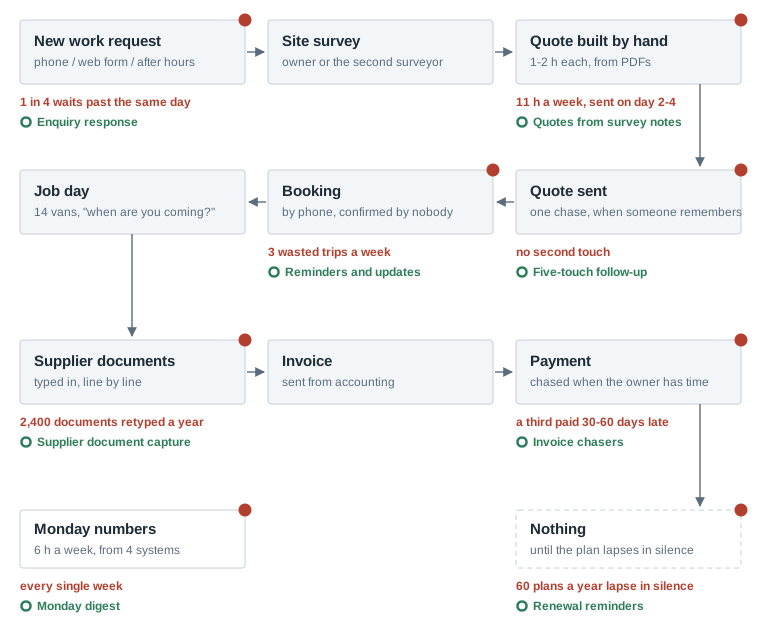
One new work request passes through six hands and four systems before it becomes money in the bank.

Most steps are fine. The leaks sit at the handovers: the call nobody picks up, the quote that takes three evenings, the booking nobody confirms, the invoice nobody chases, and the Monday that starts with a spreadsheet.

Also seen, not ranked. Six smaller leaks came up on the call and did not make the top six: your inbox, about an hour a day; social posts written between jobs when someone remembers; outreach to property managers done by hand, twice a year; a CRM trial paid for and never finished; an automation between the web form and the spreadsheet that stopped working in March and was never noticed; and new-hire paperwork rebuilt from scratch for every apprentice. None of them is small enough to ignore forever and none is big enough to come before the five above. They wait for the second map.

The path of one new work request today, from first call to money in the bank.

Flow diagram. A new work request arrives by phone, web form or after hours, leads to a site survey, a quote built by hand and sent on day 2-4, then a booking made by phone with no reminder, the job day with 14 vans on the road, parts and supplier documents, an invoice, and after the job nothing until the plan lapses. A weekly side loop is your Monday numbers. Leaks marked in the flow, with the fix from the findings named next to each, are one in four requests waiting past the same day and quotes with no second touch (enquiry response and follow-up), 14 hours a week of quoting (quotes from the survey notes), four wasted trips a week (customer reminders and updates), 3,000 supplier documents retyped a year (supplier document capture), invoices nobody chases and 75 plans a year lapsing in silence (renewal reminders and invoice chasers), and a 6-hour Monday routine (the Monday digest).

The path of one new work request today, from first call to money in the bank.LeakFix

The Opportunity Map

Six fixes, ranked by what each one gives back - hours freed and money recovered.

The Opportunity Map
#OpportunityHours nowHours freedMoney leakingMoney back
1Enquiry response and follow-upAutomate, AI optionalFocused projectn/an/a€52,800€26,400
2Renewal reminders and invoice chasersAutomate, no AI neededSame-week fixn/an/a€34,000€17,000
3Quotes built by hand from the survey notesAutomate with AIFocused project14 h9.8 h€7,950€3,975
4Customer reminders and updatesUse an existing toolSame-week fixn/an/a€20,800€10,400
5Supplier documents keyed in by handUse an existing toolFocused project8 h5.6 h€6,000€3,000
6The Monday numbers, assembled by handAutomate, no AI neededFoundation build6 h4.2 hn/an/a
Total28 h19.6 h€121,550€60,775

Row order is ours, weighing the hours a fix frees against the money it recovers. The two are kept in separate columns here so rows can be compared, and an empty cell means a fix returns one kind and not the other. Where they are added together - on each finding, and in the summary - the report says so. Hours freed assume the adoption rate in this report, money back the recovery rate, and every money leak is sized under 'How we sized it'.

Quick wins
Mid-size swings
Heavy lifts
High
Enquiry response and follow-upMoney win€26,400/yr (Impact: High, Effort level: Medium, Mid-size swings)Quotes built by hand from the survey notesTime win9.8 h/wk (Impact: High, Effort level: High, Heavy lifts)Renewal reminders and invoice chasersMoney win€17,000/yr (Impact: High, Effort level: Low, Quick wins)The Monday numbers, assembled by handTime win4.2 h/wk (Impact: High, Effort level: High, Heavy lifts)
Medium
Supplier documents keyed in by handTime win5.6 h/wk (Impact: Medium, Effort level: Medium, Mid-size swings)Customer reminders and updatesMoney win€10,400/yr (Impact: Medium, Effort level: Low, Quick wins)

Low

Medium

High

Effort level

Dot colour = the zone named above its column. Each dot is labelled with its dominant win: time wins as recoverable hours per week, money wins as the recoverable share of a conservative estimate of revenue kept or errors avoided. Within one impact band, the higher a dot sits, the more that fix gives back. A fix the rest of the work depends on is raised one band, and says why on its own page.

The findings

Each finding, one page deep - what happens, why it leaks, what fixes it, and what you get back.

Enquiry response and follow-up

The office pays for every enquiry twice - once to attract it and once to lose it to whoever answered first.

What happens today

New work requests arrive by phone, web form and email, and wait. A call that lands while the office is on another line goes to voicemail; a web form waits for the next quiet moment; a quote that gets no answer gets one chase, when someone remembers. Roughly one in four requests waits past the same day.

By the time we call back, half of them have booked someone else.

Why it leaks

Nobody owns the reply. The phone system's missed-call text-back is switched off, the web form goes to a shared inbox with no alert, and follow-up depends on the office manager's memory on a day that is already full.

What fixes it

Instant reply, missed-call text-back and a five-touch follow-up cadence

Every web request gets a text and an email inside a minute, a missed call on the office line answers itself, one qualification rule routes installs to the surveyor and repairs to dispatch, and an open quote is followed up until someone replies. Rules in the systems already paid for, not AI.

Automate, AI optionalFocused projectMedium effort

Where AI would add something

The rules above answer every enquiry. AI would change what the answer says - a first reply drafted from the customer's own words rather than a template, and a short thread that asks the three things your surveyor always ends up phoning about anyway. Worth testing once the base is running, and worth judging on the reply rate it produces, because the leak here is silence and the rules already end that.

What it would cost you: A thread that talks to your customers has to say it is AI under Article 50 of the EU AI Act, it needs a rule that hands off to a person the moment it cannot answer, and someone reads what it sent for the first few weeks. That is why it is an option to test later, not step one.

What stays human

The conversation. The text buys time and the cadence covers silence; a person still wins the job.

What you get back

Revenue at stake

€26,400Money win / year

of €52,800 leaking per year, at 50% recovery

How we sized it: Two leaks, one on each side of the finding. On the reply side, about 1,200 new work requests a year, roughly 300 wait past the same day, and by the time the office calls back about half have booked someone else - your own estimate on the call - so 150 are lost to the delay x €800 contribution on an average won job (installs and repairs blended) x 30% a same-day answer would have won = €36,000. The 30% sits above the 22% you convert across all enquiries (265 won of 1,200) on purpose, because that 22% is a blend that already includes every enquiry answered fast. On the follow-up side, of the 265 quotes a year that do not convert, a five-touch cadence re-engages about 8%, so 21 of them x €800 = €16,800. Together = €52,800.

Money · Medium confidence

What changes, and how you'll know

Today: One request in four waits past the same day. Reply time itself is not measured.

After the fix: Every request answered in five minutes, one minute after hours. Every open quote chased five times.

Measure in 90 days: Median reply time, from the phone log. Replies per ten quotes, from the CRM.

Renewal reminders and invoice chasers

The cheapest money on this map. Two scheduled rules on data you already hold, and neither of them has to wait for anything else to be built.

What happens today

A maintenance plan renews only if someone notices the date, and a late payer gets chased when the Monday spreadsheet reminds you they exist. About 75 plans a year lapse in silence, and roughly a third of what goes out on credit terms is paid 30 to 60 days late.

Half the plans that lapse, I find out when the customer rings about something else entirely.

Why it leaks

Nothing watches the dates. The plan list knows when each plan lapses and the accounting system knows which invoices are overdue; neither of them sends anything, so both depend on someone remembering on a Monday.

What fixes it

Scheduled renewal reminders and a three-step invoice chaser

Thirty days before a plan lapses, the customer hears from you. An overdue invoice gets the standard nudge at 7, 14 and 30 days, and anything still unpaid after that goes to a person. Deterministic, on lists that already exist.

Automate, no AI neededSame-week fixLow effort

What stays human

The phone call after the third reminder, and any customer who disputes an invoice. The rules only cover silence.

What you get back

Revenue at stake

€17,000Money win / year

of €34,000 leaking per year, at 50% recovery

How we sized it: About 75 of 1,450 maintenance plans a year lapse in silence with no renewal reminder x €300 lifetime margin per plan = €22,500, plus about €11,500 on the €970K invoiced on credit terms - 0.75% written off or settled at a discount because nobody chased (€7,000) and about €4,500 of overdraft interest on the third that is paid 30-60 days late (€323K, 45 days, 12% a year) = €34,000.

Money · Low confidence

What changes, and how you'll know

Today: Six plans a month lapse unnoticed. A third of credit invoices pay 30 to 60 days late.

After the fix: Every plan reminded 30 days out. Every overdue invoice chased at 7, 14 and 30 days.

Measure in 90 days: Renewals per month against last year, from the CRM. Days-to-paid past 30 days, from accounting.

Quotes built by hand from the survey notes

Quoting is your single biggest time sink - the best part of two days every week - and the slow, hand-built quote loses jobs and margin on its own.

What happens today

Every install quote is built from the surveyor's notes, the supplier price lists and a previous job that looked similar. One to two hours each, ten or so a week between the two surveyors, sent on day 2-4 after the visit - and a flue kit or a control pack goes missing from one in twenty.

I do the quotes at the kitchen table after the kids are in bed. Nine, ten o'clock.

Why it leaks

Prices live in three supplier PDFs and last year's quotes, so every quote is archaeology - find a similar job, copy it, adjust it, re-check the parts, re-format, attach.

What fixes it

Quote drafts from survey notes and a price book

The customer, the measurements and the parts land in a ready template pulled from the survey notes and a maintained price book, with AI drafting the job description and the parts list. The surveyor prices it and approves it before it goes out.

Automate with AIFocused projectHigh effort

What stays human

The price. Margin judgment stays with the surveyor - the workflow drafts, formats and sends.

What you get back

9.8 hTime win / week

of 14 h a week, at 70% adoption

€20,384Value of that time / year

at the €40 loaded hourly cost, over 52 weeks

Hours · Medium confidence

Error cost

€3,975Money win / year

of €7,950 leaking per year, at 50% recovery

How we sized it: About 265 won jobs a year x 5% that carry a missed part or a wrong price - the underpriced quote is the one that wins - x €600 of margin given away on each (a flue kit or a control pack at trade price, plus the hour to fit it) = €7,950.

Money · Medium confidence

€24,359Total recoverable / year

What changes, and how you'll know

Today: Two to four days from visit to quote. One part or price missed per twenty quotes.

After the fix: Draft built from the survey notes the same day, parts priced off the price book.

Measure in 90 days: Days from survey to quote sent, from the sent folder. Parts missed per twenty.

Customer reminders and updates

Four wasted trips a week and a phone that rings all afternoon, to deliver information the job list already holds.

What happens today

Bookings are made by phone and confirmed by nobody. About four times a week a technician arrives to an empty house, a wrong time or a doorstep cancellation, and the office spends its afternoons answering "when are you coming?" calls.

Tuesday I sent Marko across town twice for nothing. Nobody home, both times.

Why it leaks

ServiceM8, the field-service app you already pay for, has confirmations, reminders and an on-the-way text built in. They are switched off, so every update is a phone call and every no-show is a surprise.

What fixes it

Reminders, on-the-way texts and a status link from ServiceM8, the app already in use

Switch on the app's booking confirmation, the day-before reminder, the on-the-way text with an arrival window, and the review request at job close. Configuration, not a build.

Use an existing toolSame-week fixLow effort

Recommended tool

ServiceM8 · already paid for, on your current plan (~€129/month for a firm this size, starting fresh) · confirmations, reminders, on-the-way texts, a booking link and review requests are included; nothing new to buy, and the settings take an afternoon

Also fits:

  • Commusoft · pricing on request (per licence, 12-month contract) · only if you ever replace the app; built for heating and electrical firms this size, with a live on-the-way link
  • Joblogic · ~€52 per user/month (£45), billed annually · only if you ever replace the app; appointment, en-route and completion alerts, with the customer portal on the top tier

Off-the-shelf tool. The result depends on setting it up right.

Prices are indicative, checked 2 September 2026

What stays human

Any change of plan. A customer who replies to a reminder reaches a person, not a menu.

What you get back

Error cost

€10,400Money win / year

of €20,800 leaking per year, at 50% recovery

How we sized it: About 4 customer-caused wasted trips a week (not home, wrong time, cancelled on the doorstep) x 52 weeks x €100 per trip (an hour of technician time, the van, and a slot that could have been billed) = €20,800.

Money · Medium confidence

What changes, and how you'll know

Today: Four wasted trips a week. Status calls take the afternoons and are not counted.

After the fix: Every booking confirmed, reminded the day before, and an on-the-way text with a window.

Measure in 90 days: Wasted trips per week, from the dispatch log. Status calls per day, from the phone log.

Supplier documents keyed in by hand

Paid data entry, for data that already arrives in digital form - and the credit note nobody claimed costs more than the typing.

What happens today

Merchant invoices and delivery notes arrive as PDF attachments and paper in the van, and are typed into the accounting system line by line - about 3,000 documents a year, twelve a working day, eight minutes each.

Merchant invoices are thirty lines each, and every one of them goes through my keyboard.

Why it leaks

The accounting system never sees the PDF - a person re-keys it, so every document costs minutes, and a duplicate, a missed credit note or a price above the agreed rate slips through with the rest.

What fixes it

OCR capture into the existing accounting software

Forward the PDF or photograph the delivery note, check the extracted lines against the order, approve. Rules-based, and every document stays a draft until a person releases it.

Use an existing toolFocused projectMedium effort

Recommended tool

AutoEntry · ~€145/month (500 credits; a document with line items costs 2, so 250 a month needs the full 500) · Sage-owned; captures line items and posts to Sage, Xero and QuickBooks for approval; EUR pricing

Also fits:

  • Dext · ~€28/month (£24) for 250 documents and 5 users, plus line-item extraction from ~€20/month (£17) · 250 a month sits right on the plan's limit, and only 5 line-item documents a month are included; the rest need the paid add-on
  • Datamolino · ~€95/month (250 documents a month, line items included) · line items need the middle plan; connects to Xero and QuickBooks, not Sage

Off-the-shelf tool. The result depends on setting it up right.

Prices are indicative, checked 2 September 2026

What stays human

Approval. Nothing posts to accounting and nothing gets paid without a person confirming the capture.

What you get back

5.6 hTime win / week

of 8 h a week, at 70% adoption

€11,648Value of that time / year

at the €40 loaded hourly cost, over 52 weeks

Hours · High confidence

Error cost

€3,000Money win / year

of €6,000 leaking per year, at 50% recovery

How we sized it: About 3,000 supplier documents a year x 2% carrying a missed credit note, a duplicate, or a price above the agreed rate x €100 recovered or avoided per catch = €6,000.

Money · Medium confidence

€14,648Total recoverable / year

What changes, and how you'll know

Today: All 3,000 documents a year typed by hand. Catches are noticed, not counted.

After the fix: Documents arrive in the approval queue already read. Nothing is typed.

Measure in 90 days: Documents posted without typing, and catches per month, both from the queue.

The Monday numbers, assembled by hand

Six hours every Monday to learn numbers the four systems already know.

What happens today

Every Monday you rebuild the week from four systems by hand - jobs done, invoices out, cash in, plans due - before the week has started. Six hours, most weeks.

Monday is my spreadsheet day. By the time I know where we are, it's Tuesday.

Why it leaks

Jobs, invoicing, the bank and the plan list live in four tools with no bridge between them, so you are the bridge.

What fixes it

A Monday digest across the four systems

The week's jobs, invoices out, cash in and plans due arrive in one email at 07:00, in the same order every week. Deterministic, same numbers, zero typing. It is the only item that needs the four systems joined up, which is why it is a foundation build.

Automate, no AI neededFoundation buildHigh effort

What stays human

What to do about what it says. The digest reports; every decision it informs stays yours.

What you get back

4.2 hTime win / week

of 6 h a week, at 70% adoption

€8,736Value of that time / year

at the €40 loaded hourly cost, over 52 weeks

Hours · Medium confidence

Why it ranks here

The hours above are the smallest on this map and they understate it twice over: they are your own Monday, priced at the same blended rate as everyone else's. And joining those four systems is work any later fix would otherwise have to do for itself, which is why it ranks with the biggest rather than with its own number.

What changes, and how you'll know

Today: Six hours most Mondays, rebuilt by hand from four systems.

After the fix: One email at 07:00 with the same four numbers. The rebuilding stops that week.

Measure in 90 days: Monday reporting time, and whether you open the digest instead of rebuilding.

Quick wins you can start this week

Five hours a week you can take back before a single workflow is built.

Four moves you can make before any workflow is built, worth about five hours a week between them. None of these came up on the call: they are what we would start with in a business set up like yours. Two are also groundwork for the fixes above, the enquiry response and the quotes built by hand.

Switch on an instant reply to the website form, delayed thirty seconds

A text and an email go out inside a minute of the form landing. The thirty-second delay keeps it from reading as a bot.

Why: The enquiry fix is a focused project and will take weeks to scope. This covers the same gap from Monday, on the channel where silence costs you most, and it is a setting in software you already pay for.

1.5 h/wk

Put an AI note-taker on every survey call and site visit

It records and transcribes, so the surveyor stops writing up from memory in the evening.

Why: It pays twice. The evening admin stops this week, and when the quote workflow is built it needs exactly these notes as its input, so nothing you do here gets thrown away.

A free tier is enough to start.

2 h/wk

Start a 13-week cash sheet, updated every Monday with cleared cash only

One tab, thirteen columns, cleared cash only, never invoices sent.

Why: It answers the payroll question at a glance, which is most of what the six-hour Monday is for. Keeping it by hand for a quarter also shows you exactly which numbers the digest has to carry before anyone builds it.

1 h/wk

Ask for a review at sign-off, from a saved text

One saved message on the technician's phone, sent at the doorstep.

Why: A review asked for at the doorstep is the only one you reliably get, and reviews are what a stranger reads before deciding who to call. This is a habit, not a campaign.

0.5 h/wk

Quick wins total

5 h/wk

These are actions, not automation, so the assumptions at the top of this report do not change them. They also sit outside the map totals: where one touches a workflow that appears in the map, it is the part you can do this week, not a saving on top of the fix.

What not to automate

Three areas where a person stays in charge and automation only carries the paperwork.

Not everything on the pain list should be automated. Three areas came up where the answer is a person, and the reason is different in each case. What they share is the shape of the answer, not the reason for it: in all three, automation still carries the paperwork around the decision. It just never makes the decision.

Pricing and negotiating the big installs

A heat-pump or full-rewire quote is where you win or lose the year.

Stays human

Why it stays with a person

Judgment is the product. A templated price loses you either the job or the margin, and which of the two it loses depends on a conversation with the customer that no rule can hold.

What automation still does

The quote workflow still drafts the document and the parts list, so the surveyor starts from a finished draft. The price, the options and the conversation stay with him.

Refunds, warranty decisions and paying suppliers

Three places where a wrong click costs real money and a customer.

Stays human

Why it stays with a person

A mistake here does not cost a redo. It costs a refund, a supplier relationship, or a customer who does not come back, and that asymmetry is the whole reason the step keeps a person.

What automation still does

Automation prepares each one as a draft - the credit, the warranty claim, the payment run - and queues it. A person approves. Nothing moves money without that click.

Emergency triage when the day breaks

A boiler down in January with three vans already out is a judgment call, not a rule.

Not yet

Why it stays with a person

Not never, just not yet. There is no written rule for who moves and who waits, so there is nothing for a workflow to follow. Write the rule down over one winter and this becomes automatable.

What automation still does

Telling the customer can be automated today, the moment their slot changes. Deciding whose job slips cannot, until the rule exists.

Where to start

Fix the front door first. Everything else queues behind the phone.

The order follows one rule: fix the constraint first. The phone is the front door the whole business queues behind - and the first three steps are rules and settings in systems you already have, so the one foundation build at the end is funded by measured results, not projections.

  1. Enquiry response and follow-up live

    Text-back on the office line, instant replies, one routing rule and the five-touch cadence. Rules, not AI. From day one, no request waits and no quote goes quiet.

    €26,400
  2. Reminders and updates from the field-service app

    The app is already paid for. Switch on confirmations, reminders and the on-the-way text, and the wasted trips start to fall the same week.

    €10,400
  3. Renewal reminders and invoice chasers

    Two scheduled rules on lists that already exist. Nothing to integrate, so the plans stop lapsing and the invoices start chasing themselves from week one.

    €17,000
  4. Supplier document capture

    Forward, check, approve. The keying stops, and the missed credits and duplicates surface in the approval queue.

    5.6 h€3,000
  5. Quotes drafted from the survey notes

    The biggest time sink, after the smaller fixes have proven the office can absorb change. The surveyor still prices every line.

    9.8 h€3,975
  6. The Monday digest

    The one foundation build on this map, and the only item that needs the four systems joined up. It waits on purpose, for 60 days of measured results from the fixes above and a clean job list to build on.

    4.2 h
  7. Each step shows what it gives back once it is running, hours a week and money a year, the same figures as the map above.

What this leaves you with

  • One contact historySteps 1, 2, 3

    Three of these fixes message your customers: enquiry replies, booking reminders, renewal and invoice chasers. They will send from different systems, and that is fine, it is what makes step 2 free. What they need to share is a record of what already went out, so the invoice chaser does not land on the customer who cancelled on the doorstep yesterday. Worth agreeing at step 1, when there is one sender, rather than retrofitting at step 3, when there are three.

  • One bridge between the four systemsSteps 3, 4, 6

    The renewal rules read the plan list and the accounting ledger. Document capture writes into accounting. The Monday digest joins jobs, invoicing, the bank and the plan list. Step 6 is the only one that pays for that join in full, which is why it comes last.

  • One place the numbers liveEvery step

    Every finding above names something to measure, and today each one sits somewhere different: the phone log, the dispatch log, the sent folder, the supplier statements, the CRM. The digest is where they land, which is what makes it the thing that tells you whether the other five worked.

What gets cheaper
The six smaller leaks in section 3 that did not make this map are mostly either sending a message or joining two records, and both exist by step 6. That is a second map, not a second build from scratch.
What stays yours
Every fix above runs in a system you already own and pay for, on your accounts and your keys. You do not end up on a platform of ours, and you can stop after any step and keep everything it gave you.

Your numbers

Nothing here is a black box. Every number traces to an assumption you can change.

Two layers of assumption sit under every number. The four in the box below scale the whole report: change one and every figure moves with it, from the summary tiles to each finding. Underneath those sit the volumes and rates inside each money leak - how many requests a year, what a won job is worth, how often a document carries an error. Those are printed under "How we sized it" on the finding they belong to, and collected at the end of this section. Correct one of those and only that line moves. The printed copy uses our conservative defaults throughout.

Don't take our assumptions. Drag yours, and watch the whole report recalculate.

Recoverable value = leaking hours x adoption x hourly cost x 52 weeks. Recoverable money = money leak x recovery rate. Total recoverable adds both.

€101,543total recoverable per year
19.6 hrecoverable per week
€60,775money recoverable per year

How each money leak was sized, collected from the findings

  • Enquiry response and follow-up (Revenue at stake · Medium confidence): Two leaks, one on each side of the finding. On the reply side, about 1,200 new work requests a year, roughly 300 wait past the same day, and by the time the office calls back about half have booked someone else - your own estimate on the call - so 150 are lost to the delay x €800 contribution on an average won job (installs and repairs blended) x 30% a same-day answer would have won = €36,000. The 30% sits above the 22% you convert across all enquiries (265 won of 1,200) on purpose, because that 22% is a blend that already includes every enquiry answered fast. On the follow-up side, of the 265 quotes a year that do not convert, a five-touch cadence re-engages about 8%, so 21 of them x €800 = €16,800. Together = €52,800.
  • Renewal reminders and invoice chasers (Revenue at stake · Low confidence): About 75 of 1,450 maintenance plans a year lapse in silence with no renewal reminder x €300 lifetime margin per plan = €22,500, plus about €11,500 on the €970K invoiced on credit terms - 0.75% written off or settled at a discount because nobody chased (€7,000) and about €4,500 of overdraft interest on the third that is paid 30-60 days late (€323K, 45 days, 12% a year) = €34,000.
  • Quotes built by hand from the survey notes (Error cost · Medium confidence): About 265 won jobs a year x 5% that carry a missed part or a wrong price - the underpriced quote is the one that wins - x €600 of margin given away on each (a flue kit or a control pack at trade price, plus the hour to fit it) = €7,950.
  • Customer reminders and updates (Error cost · Medium confidence): About 4 customer-caused wasted trips a week (not home, wrong time, cancelled on the doorstep) x 52 weeks x €100 per trip (an hour of technician time, the van, and a slot that could have been billed) = €20,800.
  • Supplier documents keyed in by hand (Error cost · Medium confidence): About 3,000 supplier documents a year x 2% carrying a missed credit note, a duplicate, or a price above the agreed rate x €100 recovered or avoided per catch = €6,000.

recoverable per week: 19.6 · money recoverable per year: €60,775 · total recoverable per year: €101,543

Assumptions in this report

Loaded hourly cost: €40 · Hours flows currently take: 28 h/wk · Adoption rate: 70% · Recovery rate: 50%

28 h/wk leaking per week (= €58,240 a year in labour) · €121,550 leaking per year in errors and missed revenue

19.6 h/wk recoverable per week (= €40,768 a year in labour) · €60,775 money recoverable per year · €101,543 total recoverable per year

Recoverable value = leaking hours x adoption x hourly cost x 52 weeks. Recoverable money = money leak x recovery rate. Total recoverable adds both.

How each money leak was sized, collected from the findings

  • Enquiry response and follow-up (Revenue at stake · Medium confidence): Two leaks, one on each side of the finding. On the reply side, about 1,200 new work requests a year, roughly 300 wait past the same day, and by the time the office calls back about half have booked someone else - your own estimate on the call - so 150 are lost to the delay x €800 contribution on an average won job (installs and repairs blended) x 30% a same-day answer would have won = €36,000. The 30% sits above the 22% you convert across all enquiries (265 won of 1,200) on purpose, because that 22% is a blend that already includes every enquiry answered fast. On the follow-up side, of the 265 quotes a year that do not convert, a five-touch cadence re-engages about 8%, so 21 of them x €800 = €16,800. Together = €52,800.
  • Renewal reminders and invoice chasers (Revenue at stake · Low confidence): About 75 of 1,450 maintenance plans a year lapse in silence with no renewal reminder x €300 lifetime margin per plan = €22,500, plus about €11,500 on the €970K invoiced on credit terms - 0.75% written off or settled at a discount because nobody chased (€7,000) and about €4,500 of overdraft interest on the third that is paid 30-60 days late (€323K, 45 days, 12% a year) = €34,000.
  • Quotes built by hand from the survey notes (Error cost · Medium confidence): About 265 won jobs a year x 5% that carry a missed part or a wrong price - the underpriced quote is the one that wins - x €600 of margin given away on each (a flue kit or a control pack at trade price, plus the hour to fit it) = €7,950.
  • Customer reminders and updates (Error cost · Medium confidence): About 4 customer-caused wasted trips a week (not home, wrong time, cancelled on the doorstep) x 52 weeks x €100 per trip (an hour of technician time, the van, and a slot that could have been billed) = €20,800.
  • Supplier documents keyed in by hand (Error cost · Medium confidence): About 3,000 supplier documents a year x 2% carrying a missed credit note, a duplicate, or a price above the agreed rate x €100 recovered or avoided per catch = €6,000.

The question you will be asked when you share this

Wouldn't a second dispatcher solve most of this?

A second person would absorb the hours - and keep every process manual. The retyping, the day-3 quotes, the unanswered evening calls and the unchased invoices would simply have a new owner, and the first holiday would bring them all back. Fix the workflows first; then decide whether the work that remains needs a person. Some businesses end up doing both, in that order.

Want a map like this built from your own operations? The audit is free right now, and it starts with a 20-minute discovery call.

Book a Free Discovery Call

This is a sample report for a fictional business. Every number is illustrative. A real report is built from your own operations.

Prepared by George Sostak · NocodePro · nocodepro.dev · 2 September 2026