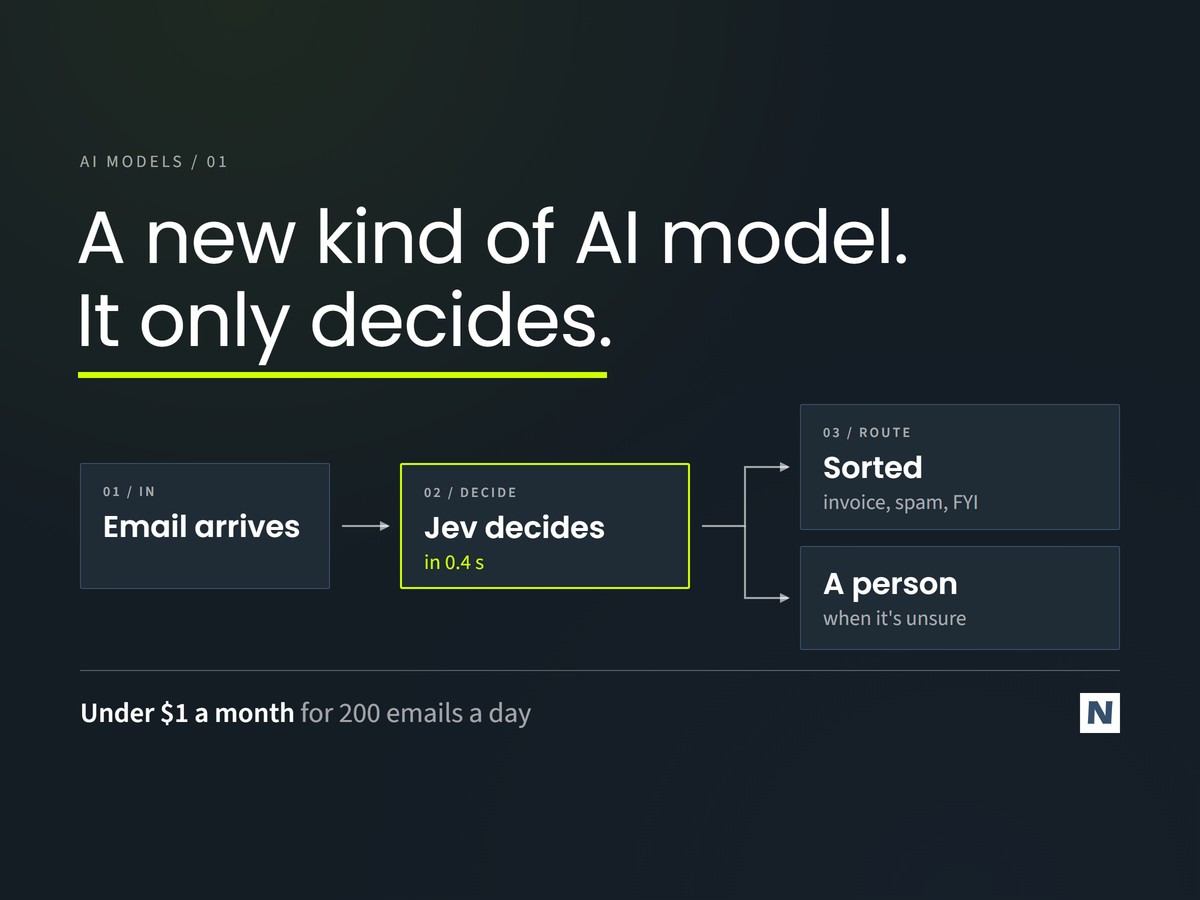

Most automation flows have a step where something has to make a call. Which team gets this ticket. Is this email an invoice. Does this enquiry deserve a reply today.
Jev AI is a new model built for exactly that step. It comes from TypeSafe, launched on 15/09/2026, and it does one thing: it answers typed questions about the information you give it and tells you how sure it is. It never writes a sentence. TypeSafe introduction
The numbers made us look twice. Typical answers come back in under half a second, and at the published price an inbox of 200 emails a day costs under a dollar a month to sort. We have already built it into our own email triage flow, so this article covers what the model is, what it costs, how accurate it is, and what we found building with it.
What Jev does inside a workflow
You send Jev two things: the information to judge, which TypeSafe calls the state, and the questions you want answered. Every question comes with its allowed answers. Question types
Three answer types cover most needs:
| Answer type | What you get back | Example |
|---|---|---|
| Choice | One of the options you defined, with a probability for each | Billing, technical, sales or other |
| Score | A position on a scale you describe | Routine, disruptive or business-stopping |
| Noul | The probability that a yes/no statement is true | Does this message ask for a refund? |
One request can carry many questions. Each is answered on its own, in parallel, so adding questions barely changes the response time. Your code then combines the answers into a route or an action.
What it is not: a chat model. It can't draft a reply, summarise a thread or write code, and it can't sit behind a coding assistant. TypeSafe says so plainly in its own docs. Jev and coding agents Where your flow needs words, a language model still writes them. Jev decides what happens next.
How fast, how cheap, how accurate
Speed
TypeSafe quotes 70 to 500 milliseconds end to end. In our own first test, run from a Trigger.dev task, 4 of 5 answers came back in under 0.4 seconds and the slowest took 1.1 seconds. That is fast enough to decide while a customer is still looking at your form.
Cost
Jev costs $0.042 per million input tokens, and output is free. Models and pricing
| Decisions per month | Input tokens each | Jev model cost |
|---|---|---|
| 10,000 | 1,000 | $0.42 |
| 100,000 | 1,000 | $4.20 |
| 100,000 | 2,500 | $10.50 |
| 1,000,000 | 1,000 | $42.00 |
A token is a small piece of text. Count the instructions and answer options in each request, not only the message. And remember what the table leaves out: hosting, text extraction, other models and the hours spent reviewing exceptions. At small volumes those cost far more than Jev does.
Accuracy
TypeSafe publishes a benchmark across four workflows (security incidents, AI agent traces, invoice processing and customer service), scored against answers agreed by the largest frontier models. TypeSafe workflow evals
| Model | Average accuracy | Cost per case | Time per case |
|---|---|---|---|
| Jev | 67.8% | $0.0004 | 0.4 s |
| GPT-5.6 Terra | 67.9% | $0.0304 | 10.1 s |
| Claude Sonnet 5 | 67.8% | $0.1174 | 78.1 s |
| Claude Opus 5 | 73.1% | $0.1761 | 37.8 s |
| GPT-5.6 Sol | 74.1% | $0.0836 | 23.3 s |
These are the vendor's own numbers on its own workflows, so read them as a direction, not a verdict. The top models are still more accurate. Jev matches the middle of the field at a small fraction of the cost and time.
The same page holds the more useful lesson. Every model tested did better when the job was split into narrow questions than when it got the whole problem as one prompt. Claude Opus 5 went from 64.8% to 73.1%. A cheaper model with structure even beat the most expensive one without it: GPT-5.6 Luna scored 66.8% on the split-up version, Claude Opus 5 64.8% on the single prompt.
Knowing when it is unsure
An independent test by a developer outside TypeSafe used 60 hand-labelled cases, each asking how risky an AI agent's action was. Jev got 55 right. None of its mistakes came with full confidence: across repeated runs they sat between 0.13 and 0.785. Independent benchmark
That is the property that matters in automation. If the model shows when it is unsure, your flow can act on the sure answers and send the rest to a person.
What we found building it into our email triage
Our flow is built on Trigger.dev. Once switched on, it checks one inbox every ten minutes, asks Jev about each new message and plans what should happen next.
Each email gets two questions in the same call:
- a Choice: which of five buckets it belongs in (invoice, spam, needs action, FYI, important)
- a yes/no: must a person read it before anything is done with it
Here is what building it taught us.
- The model call was the small part. The Jev request is a few dozen lines of code. Nearly all the work went into the rules around it: which answers may act on their own, and what happens to the rest.
- Two questions do two jobs. The bucket says where an email goes. The yes/no says whether a person has to look first. An email can be clearly an invoice and still need a human because something about it is unusual.
- Confidence decides the path. Below 0.85 confidence the flow only proposes an action. Spam is filed automatically only from 0.95 up. The cutoff for the yes/no is still open; we will choose it after testing on our own mail, not from a demo.
- Email is treated as hostile. Every question tells the model that the message is untrusted data and that instructions inside it must be ignored. TypeSafe's docs warn that the model does not treat content as hostile by default.
- Some actions are impossible by design. The flow cannot delete or bin anything, never sends an ordinary reply, and forwards invoices to one fixed address, our accountant's, only after approval in chat.
- It has to earn its place. Before it touches real mail it runs against a few hundred of our past emails with known answers, next to three alternatives: simple rules, Claude Haiku and a small OpenAI model. The report compares accuracy per bucket, how well confidence matches reality, cost and speed. Only after that does it get to act.
Where it stands today: built, deployed and connected, and it sorted our test messages correctly. It has not yet sorted a single real email.
Four more flows where it fits
These are designs based on the documented capabilities, not measured client results.
New enquiries
Ask whether the message is a real lead or a sales pitch, how well it fits what you sell, and whether volume, timing or the decision-maker is missing. Good leads reach a person within minutes; vague ones get a clarifying question. Most firms take about two days to answer a new enquiry, so minutes is a real edge.
Support tickets
One call returns the team, the urgency, whether the customer wants a refund and how frustrated they are. The outage that costs a customer money jumps the queue, and anything unclear goes to a person. Measure the expensive mistake: urgent tickets marked as routine.
Document intake
Invoices, contracts and purchase orders often land in the same inbox. Extract the text first, because Jev reads text only, then ask which document it is, with an "other" option for the unexpected. Each type goes to its own process. Keep totals and dates in your accounting software: in TypeSafe's own words, "Jev is not a calculator."
Checking drafts written by a chat model
If a language model drafts your replies, Jev can check each draft before it goes out: does it answer the question, does it promise anything your policy doesn't allow, does it contain someone's personal data. The check costs a fraction of writing the draft.
Build around its limits
TypeSafe publishes a list of the model's weak spots, and it is worth reading before you design anything. Known limitations
- Counting, arithmetic and date comparisons belong in your code.
- It answers the question you wrote, not the one you meant. Spell out the edge cases.
- Irrelevant context lowers accuracy. Send only the fields a question needs.
- Text inside the content can steer it. Treat every message as untrusted.
- It reads text only, and English best. Other languages work at lower accuracy, so test in yours.
The confidence number needs care too. A confidence of 0.9 is not a promise of 90% accuracy on your data. Set your thresholds from your own labelled examples. Confidence
A practical first pilot
I'd start with one busy queue where the right answer is easy to check.
- Take 100 to 200 past cases, awkward ones included, and have someone who knows the process label the right outcome.
- Write narrow questions. "Is this spam" hides several judgments; ask about each one separately and combine the answers in code. TypeSafe's build guide calls this probably the most important concept it teaches.
- Give every question an explicit "other" or "needs a person" answer.
- Run Jev against the labels and count the mistakes that cost money, not only the overall score.
- Run it next to your current process before it acts on its own.
Getting access, and your data
You can request a key from TypeSafe directly, or call Jev through Vercel's AI Gateway or OpenRouter, where it is in beta. TypeSafe says it does not train on customer data and offers zero data retention to enterprise customers. Legal If you handle personal data from the EU, read its data processing agreement before you send real records.
Common questions about Jev
Can Jev write customer replies?
No. It returns decisions. Use a language model for the words, after Jev has picked the next step.
Can it read scanned invoices?
Not directly. It reads text, so extract the text first.
Does free output mean free automation?
No. You pay for Jev's input and for everything around it: hosting, extraction, other models and review time.
Is it accurate enough for my business?
Only a test on your own cases can tell you. The useful answer is a measured error rate for one task, not a general promise.
If your team sorts a queue by hand every day, map the decisions before you pick a model. The AI Readiness Checklist walks you through that, and if you want a second opinion on which step to start with, that is the question our AI audit is built to answer.