
Most small businesses that use AI pay $20 to $100 a month for a chat tool. ChatGPT, Claude, Gemini, pick your favorite. And they use it to rewrite emails.
That's like buying a forklift and using it as a doorstop.
They save ten minutes a day and wonder what the hype is about. The tool isn't the problem. The mode is. This is a plain guide to AI agents for small business owners who already pay for AI chat and feel it should be doing more.
Since July, ChatGPT's own app has a second mode next to Chat. It's called Work. That button is what this article is about.
What are AI agents? A head with hands
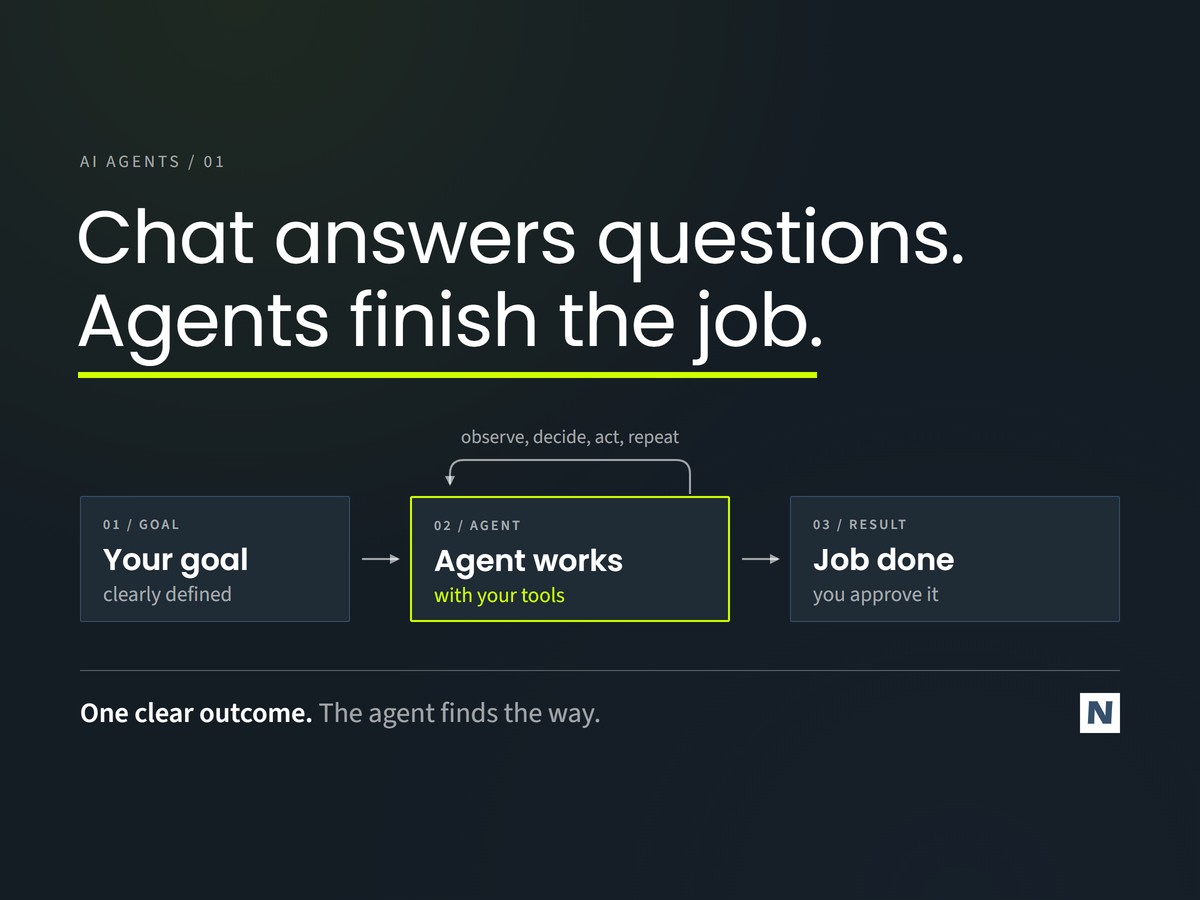
An AI agent is an AI model that can act, not just answer. You give it one clearly defined outcome. It plans the steps, uses your tools (email, calendar, CRM, files), checks what happened after each step and keeps going until the job is done. It asks you before anything important.
The way I think about it: AI chat is a very knowledgeable head with no hands. It can tell you almost anything. It can't do anything. An agent gives that head hands, and the hands are your tools.
Anthropic, the company behind Claude, defines agents as systems where the model directs its own process and tool use, "maintaining control over how they accomplish tasks". I'd underline that last part. You decide what done means. The agent decides how to get there.
ChatGPT vs AI agents: question to answer, outcome to result
Here's what AI looks like in most small businesses right now:
- Open your AI chat
- Type a question
- Get an answer
- Copy-paste it somewhere
- Come back 20 minutes later with another question
- Repeat
I call this ping-pong mode. You ask, it answers. You do all the thinking about what to ask, when to ask it and what to do with the answer. The AI waits for you, and you're still doing most of the work.
The difference fits in two lines:
- Chat = question to answer
- Agent = outcome to result
Take a follow-up email. In chat, you type "draft me a follow-up email to this client." The AI writes the email. You copy it, open your email app, find the contact, paste, tweak and hit send. The AI did one step. You did six.
With an agent, you say "follow up with every client who hasn't replied in 7 days, with a personal check-in." It finds the clients, checks your last exchange with each one and drafts every email with the right context. You review the batch, approve, and it sends.
One clearly defined outcome. The agent works out the steps.
OpenAI drew the same line in July. Its new ChatGPT app puts Chat "for questions and conversation" and Work "for research and finished deliverables" side by side, in the same subscription.
An agent works more like a new employee than a search box. You onboard them. They learn how your business runs and who your customers are. Then you give them a goal, and they don't wait for you to tell them every move.
The agent that found a better way
A real one, from my own desk.
I needed six years of my own records from a government portal. The portal lets you download one file at a time, one click each. I pulled a few by hand and gave up. Too slow.
So I recorded myself downloading one file with ReplayDoc, a tool we built that turns a screen recording into a step-by-step procedure an AI agent can follow. I handed that procedure to my agent (Claude Code, driving a real Chrome window), logged in, and let it run.
It followed my steps for the first few files. Then it stopped and asked me something. It had found a better way: go straight through the portal's system instead of clicking through the screens. Could it switch?
I said yes.
The portal's screen listed 98 files. The agent pulled 174, including a batch from the oldest years that the screen never showed me. It got logged out halfway and logged back in. Two of the oldest files were broken on the portal's side, so it flagged them instead of pretending it had them. Then it renamed everything, sorted it into folders and indexed it.
An afternoon of clicking turned into a progress log I read over coffee.
Here's the lesson. I gave it instructions, step by step. What it held on to was the outcome: every file, in one place. That's why "outcome to result" beats "question to answer". You define the outcome clearly. A good agent works out the route, sometimes a better one than yours, and asks before it changes course.
How AI agents work
Chat gives you the first of these four parts. An agent needs all of them.
1. The head (the language model). The same technology behind ChatGPT, Claude and Gemini. It reasons, writes, analyzes and decides. In chat, this is all you're using. It doesn't always need to be the biggest model, either: in the email triage flow we built, a small model that only makes decisions sorts each email, and plain automation does the rest.
2. The loop. This is what makes an agent an agent. Instead of one question and one answer, it works in cycles: look at the situation, decide the next step, act, check the result. Then again, until the outcome is reached. Chat stops after one reply. An agent keeps working.
3. The hands (the tools). Connections to the systems your business runs on: CRM, email, calendar, spreadsheets, a browser. They turn "write me an email" into "send personal follow-ups to 15 clients from my CRM, log each one and flag anyone who replies within 24 hours." Without tools, AI is stuck in a text box.
4. The context. What the agent knows about your business: your tone, prices, products, client history, how you do things. Context is why one answer sounds like your team wrote it and another sounds like a stranger did.
Context is the part that gets skipped. Writing better prompts matters less than giving the AI the right background about your business. Better context, better output. Every time.
The first thing to check is whether that background exists, written down and in one place. Two of the six sections in our AI Readiness Checklist test exactly that: how well your processes are documented, and whether your data is ready to use.
Free Checklist
AI Readiness Checklist
Free 30-question AI readiness checklist for business owners. Score your operations in 10 minutes, read the verdict for your tier, and know what to fix first.
What AI agents look like in a small business
Three scenarios, with the numbers I would expect in an owner-run business.
Client follow-ups
Chat: you ask the AI to draft a follow-up. Paste in the client's name and some context. Get a generic email back. Edit it for 5 minutes. Send it by hand. Ten clients, about 90 minutes.
Agent: every morning the agent checks your CRM and picks out who needs a follow-up by your rules (no reply in 5 days, proposal sent but not signed, a milestone coming up). It drafts each email from that client's history. You read ten drafts in 5 minutes and approve.
An hour and a half of your morning becomes five minutes of reading. Every day.
Weekly reporting
Chat: pull numbers from 3 tools. Paste them into the chat and ask for a summary. Copy it into a doc, format it, email it to the team. 45 minutes every Friday.
Agent: every Friday at 08:00 it pulls the numbers from your analytics, CRM and project tool, builds the report with the key figures and next actions, and sends it to the team.
45 minutes becomes zero. Every week. That's 39 hours a year on one task.
New leads
Chat: a lead comes in through your website form. You look them up on LinkedIn, decide whether they fit, draft a reply and add them to your CRM. 15 to 20 minutes a lead.
Agent: it reads the form, looks up the company (size, industry, LinkedIn), scores the fit against your ideal client and drafts a personal reply plus the CRM entry. A poor fit gets a polite redirect. Once you trust it, the reply goes out within 2 minutes. You get one summary a day.
15 minutes a lead becomes 30 seconds of review. Multiply that by a handful of leads a week and the math gets obvious fast.
Where to start with AI agents in a small business
You don't need a big build to start. You need one task, written down.
- Check what you already pay for. ChatGPT Plus now includes Work, OpenAI's agent. Claude's $20 Pro plan lists handing off and scheduling tasks, Claude in Chrome and connections to your apps. Google is the exception: its Gemini Agent sits on the Ultra plan, which starts at about $100 a month, and only in the US, in English. Try the tool you have before you buy another one.
- Pick one narrow task with a clear outcome. A follow-up, a weekly report, a reply to new leads. "Run my admin" is not a task.
- Write the context down. The steps, the rules, the exceptions, the tone. If it only lives in your head, the agent can't use it.
- Keep approvals on. It drafts, you approve, until it has earned your trust. The better agents are built for this: ChatGPT Work asks before important actions, and mine asked before it changed route.
- Count the hours. Before and after. If the number doesn't move, change the task before you change the tool.
Which agent is best, then? Whichever one can reach your systems and has your context. For most owners that is already inside the subscription they pay for.
Why AI agents matter for small business now
Big companies are moving. Gartner expects 40% of enterprise applications to carry task-specific AI agents by the end of 2026, up from under 5% in 2025.
Small ones mostly aren't. The US Census Bureau's business survey found that between December 2025 and May 2026, AI use rose among firms with 20 or more employees and didn't change among smaller ones. Fewer than one in five of the smallest firms use AI at all.
That gap is the opening.
I've seen this pattern before. I've spent 12,000+ hours building apps, 10,000+ of them in Bubble. When Bubble first came out, developers dismissed it. "It's not real development." The businesses that adopted it early built products in weeks instead of months. They moved faster than competitors with far bigger engineering budgets.
AI agents are at that point now. The repetitive work goes to the agent. Your team keeps the work that needs a person: the client calls and the deals.
The gap between using AI and using AI agents is the gap between saving 10 minutes a day and saving 10 hours a week.
Common questions about AI agents for small business
Is ChatGPT an AI agent?
Chat on its own is not: it answers and stops. Since July 2026 ChatGPT also has Work, which is an agent. You give it an outcome, it works across your connected apps and files, and it asks you before important actions. Which one you get depends on the mode you open.
Which AI agent is best for a small business?
The one with access to your systems. An agent that can't reach your CRM, inbox or files is back to being a head with no hands. Start with the agent features in the subscription you already pay for, write your process down, and compare new tools only after that.
How much does an AI agent cost for a small business?
The agent features in ChatGPT Plus and Claude Pro come with their $20 a month plans. An agent built around your own systems is a project, priced by its scope. Either way, most of the cost is setup: writing down the context and connecting the tools.
Do I need to code to use an AI agent?
No, not for the agents inside the chat subscriptions. You describe the outcome in plain words. Connecting an agent to your CRM, inbox or accounting tool is setup work. Some owners do it themselves. Others bring in someone who does it for a living.
What to do about it
Pick one outcome and write down what the agent needs to know to reach it. Keep your approval on anything that leaves the building.
Then you need someone who understands the technology and your operations well enough to connect the two. That's what we do at NocodePro.
We run an AI audit. We map your current operations and find where agents (not chat) would save you real time and money. No sales pitch. We look at your actual workflows and show you where the biggest opportunities are. Here is what a finished map looks like.
If AI agents aren't the right move for your business, we'll tell you that too.
It starts with a 20-minute discovery call, then a 90-minute audit, then your AI Opportunity Map as a live report page. The audit is free right now.
Not ready to talk? Score your operations first. Thirty questions, ten minutes, and it tells you what to fix before any agent is worth building.